
Gold Street is in Walgrave, Northampton and in West Northamptonshire district. NN6 9QE is located in the Moulton electoral ward, within the English Parliamentary constituency of Daventry. This postcode has been in use since 1980-01-01.
StreetScan combines information about Gold Street, Walgrave, Northampton, NN6 9QE and displays a report on the quality of life in this place and its surroundings.
Nearby postcodes are: NN6 9QB, NN6 9PQ, NN6 9QD, NN6 9QF, NN6 9TP, NN6 9PL, NN6 9RW, NN6 9TQ, NN6 9RP.
In the UK, the overall gender distribution is approximately 49% male and 51% female. However, the area surrounding NN6 9QE, has a female population slightly higher than UK average, with 53.9% of residents being female. Several factors can contribute to this. Women generally live longer than men, resulting in a higher proportion of women in neighborhoods with significant elderly populations. Typically, as people grow older, they tend to relocate from city center addresses to suburban areas, smaller towns, and rural locations. Consequently, these areas often have a higher number of females. A higher female population can also be found in areas with industries that employ more women, such as healthcare, education, and retail.
| 2011 | 2021 | 10y change (pp) | UK Average | postcode vs UK (pp) | |
|---|---|---|---|---|---|
| Female | 52.9% | 53.9% | 1.0% | 51.0% | 2.9% |
| Male | 47.1% | 46.1% | -1.0% | 49.0% | -2.9% |
Across the UK, the average relationship status breakdown is roughly 44% married, 38% single, 9% divorced, 6% widowed, and 2% separated.
In the immediate vicinity of NN6 9QE there is a very large concentration of residents that are married - 52.9% of the resident population. In contrast, the average marriage rate across the census is about 44%.
Areas with a high percentage of married residents are typically suburban neighborhoods, towns with good schools and family-friendly amenities, and regions with affordable, spacious housing options. Additionally, such areas can be popular among retirees.
| 2011 | 2021 | 10y change (pp) | UK Average | postcode vs UK (pp) | |
|---|---|---|---|---|---|
| Single | 32.1% | 28.1% | -4.0% | 37.9% | -9.8% |
| Married: Opposite sex | 47.3% | 52.9% | 5.6% | 44.2% | 8.7% |
| Separated | 2.5% | 1.1% | -1.4% | 2.2% | -1.1% |
| Divorced | 10.5% | 9.5% | -1.0% | 9.1% | 0.4% |
| Widowed | 7.6% | 8.4% | 0.8% | 6.1% | 2.3% |
Across the UK, the average 48.4% rated their health as Very Good, 33.6% as Good, 12.7% as Fair, 4% as Bad, and 1.2% as Very Bad.
Population age significantly impacts residents' health. Additionally, socioeconomic status plays a crucial role: higher income levels and lower poverty rates are linked to better health outcomes. Affluent areas benefit from higher living standards, access to private healthcare, and healthier lifestyle choices.
| 2011 | 2021 | 10y change (pp) | UK Average | postcode vs UK (pp) | |
|---|---|---|---|---|---|
| Very good health | 38.5% | 41.9% | 3.4% | 48.4% | -6.5% |
| Good health | 38.1% | 39.2% | 1.1% | 33.6% | 5.6% |
| Fair health | 13.7% | 14.8% | 1.1% | 12.7% | 2.1% |
| Bad health | 7.9% | 3% | -4.9% | 4.0% | -1.0% |
| Very bad health | 1.7% | 1.2% | -0.5% | 1.2% | 0.0% |
During the 2021 census, the educational qualifications of residents across the UK were as follows: 18.2% had no qualifications, 9.6% had 1-4 GCSEs, 13.4% had 5 or more GCSEs and 1-2 A/AS Levels, 16.9% had 2 or more A Levels, 33.8% held a degree (or equivalent), and 5.4% had completed an apprenticeship.
| 2011 | 2021 | 10y change (pp) | UK Average | postcode vs UK (pp) | |
|---|---|---|---|---|---|
| No qualifications | 32.1% | 24.9% | -7.2% | 18.2% | 6.7% |
| 1-4 GCSEs or Equivalent | 16.9% | 9.4% | -7.5% | 9.6% | -0.2% |
| 5 or more GCSEs, an A-Level or 1-2 AS Levels | 10.5% | 12.8% | 2.3% | 13.4% | -0.6% |
| Apprenticeship | 3.8% | 4.9% | 1.1% | 5.3% | -0.4% |
| HNC, HND or 2+ A Levels | 9.7% | 14.7% | 5.0% | 16.9% | -2.2% |
| Degree or Similar | 24.5% | 29.1% | 4.6% | 33.8% | -4.7% |
| Other | 2.5% | 4.2% | 1.7% | 2.8% | 1.4% |
In this area, the population is predominantly white, with 97.9% identifying as such, significantly higher than the UK average of 81.4%. This indicates a lower level of ethnic diversity compared to the broader UK population.
| 2011 | 2021 | 10y change (pp) | UK Average | postcode vs UK (pp) | |
|---|---|---|---|---|---|
| Chinese | 0% | 0.3% | 0.3% | 0.7% | -0.4% |
| Pakistani | 0.7% | 0% | -0.7% | 2.7% | -2.7% |
| Other Asian | 0% | 0.3% | 0.3% | 1.6% | -1.3% |
| Mixed White and Asian | 0% | 1.2% | 1.2% | 0.8% | 0.4% |
| White | 99.3% | 97.9% | -1.4% | 81.4% | 16.5% |
| Gypsy or Irish Traveller | 0% | 0.3% | 0.3% | 0.1% | 0.2% |
In this area, 94.3% of the population were born in the United Kingdom, which is higher than the UK average of 83.2%.
| 2011 | 2021 | 10y change (pp) | UK Average | postcode vs UK (pp) | |
|---|---|---|---|---|---|
| United Kingdom | 96.9% | 94.3% | -2.6% | 83.2% | 11.1% |
| European Union | 1% | 3.3% | 2.3% | 6.1% | -2.8% |
| Rest of Europe | 0% | 0.6% | 0.6% | 0.8% | -0.2% |
| Africa | 0% | 1.5% | 1.5% | 2.7% | -1.2% |
| Middle East and Asia | 1% | 0% | -1.0% | 5.6% | -5.6% |
| The Americas and the Caribbean | 1% | 0.3% | -0.7% | 1.3% | -1.0% |
| 2011 | 2021 | 10y change (pp) | UK Average | postcode vs UK (pp) | |
|---|---|---|---|---|---|
| Born in the UK | 96.6% | 94.3% | -2.3% | 83.2% | 11.1% |
| 10+ Years | 0.7% | 3.3% | 2.6% | 9.8% | -6.5% |
| 5-10 Years | 0.3% | 1.8% | 1.5% | 2.9% | -1.1% |
| 2-5 Years | 0.7% | 0.6% | -0.1% | 2.2% | -1.6% |
| Less than 2 years | 1.7% | 0% | -1.7% | 1.9% | -1.9% |
| 2021 | UK Average | postcode vs UK (pp) | |
|---|---|---|---|
| United Kingdom | 79.2% | 76.7% | 2.5% |
| Poland | 2.1% | 1.3% | 0.8% |
| Romania | 0.3% | 0.9% | -0.6% |
| Other EU countries | 1.5% | 1.5% | 0.0% |
| No passport held | 16.9% | 13.5% | 3.4% |
| 2021 | UK Average | postcode vs UK (pp) | |
|---|---|---|---|
| No religion | 54.7% | 37.2% | 17.5% |
| Christian | 41.4% | 46.2% | -4.8% |
| Hindu | 0.3% | 1.7% | -1.4% |
| Not answered | 3.6% | 6.0% | -2.4% |
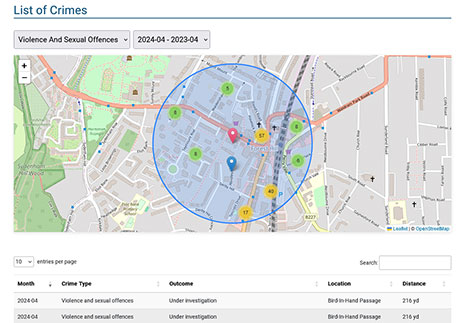
Over the last 12 months, the overall crime rate around Gold Street was 39.6 per 1,000 residents, which is 46.3% lower than the Moulton average. The most reported crime type was Anti-social behaviour.
Gold Street has the 12th lowest crime rate of 32 local areas in Moulton and the 470th lowest crime rate of 1,262 local areas in West Northamptonshire .
Violent and sexual offences accounted for around 19.8 crimes per 1,000 residents and have been rising year on year. Over the last decade, overall crime has fallen by about -83.3%.
Households in this area have a slightly higher level of wealth to the average household in England and Wales. 69% of analyzed areas in England and Wales have lower average household annual income than this area.
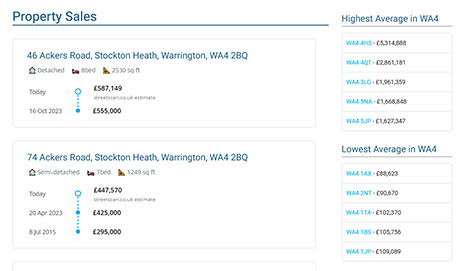
| Address | Sale Price | Sale Date | Price Estimate 2025 |
|---|---|---|---|
| The Langham Gold Street, Northampton, West Northamptonshire Detached, an established residential building | £919,000 | 2024-08-21 | £958,167 |
| Willow Bank, 2 Gold Street, Northampton, West Northamptonshire Detached, an established residential building | £470,000 | 2021-09-28 | £527,304 |
| Willow Bank, 2 Gold Street, Northampton, West Northamptonshire Detached, an established residential building | £470,000 | 2021-06-25 | £545,613 |
| The Cottage Gold Street, Northampton, Northamptonshire Semi-Detached, an established residential building | £445,000 | 2020-03-03 | £556,929 |
| Victoria House Gold Street, Northampton, Northamptonshire Detached, an established residential building | £675,000 | 2017-07-05 | £848,402 |
NN6 9QE area has a low unemployment rate. According to Census 2021, 0% residents of this area were unemployed, while the average in the UK was 4.83%. A low level of unemployment in an area indicates a strong job market, where most people who are seeking work can find employment. This generally reflects a healthy economy in the area.
| Full-Time Employee | 96 |
| Retired | 68 |
| Part-Time Employee | 31 |
| Self-Employed | 29 |
| Looking after home or family | 14 |
| Other | 8 |
| Student (economically inactive) | 7 |
| Long-Term Sick or disabled | 7 |
| Full-Time Student (with or without job) | 1 |
| Unemployed | 0 |
| Other | 17 |
| Construction | 15 |
| Wholesale and retail trade; repair of motor vehicles and motor cycles | 14 |
| Education | 13 |
| Manufacturing | 12 |
| Professional, scientific and technical activities | 10 |
| Human health and social work activities | 9 |
| Transport and storage | 8 |
| Administrative and support service activities | 7 |
| Accommodation and food service activities | 6 |
| Financial and insurance activities | 3 |
| Agriculture, forestry and fishing | 2 |
| Real estate activities | 1 |
| Public administration and defence; compulsory social security | 1 |
| Information and communication | 1 |
| Water supply; sewerage, waste management and remediation activities | 1 |
| Ofsted Overall Effectiveness | Distance | Establishment Type | Has Nursery Classes | Gender | More Info | |
|---|---|---|---|---|---|---|
| Walgrave Primary School Kettering Road , Walgrave NN6 9PH | - not rated | 425 yd | Community school | No | Mixed | More About School |
| Mawsley Primary School Scholars Row , Mawsley NN14 1GZ | 3out of 4 | 4,269 yd | Community school | No | Mixed | More About School |
| Broughton Primary School Cransley Hill , Broughton NN14 1NB | 3out of 4 | 5,305 yd | Community school | No | Mixed | More About School |
School statistics for this postcode are based on Ofsted rankings.
| Business Name | Address | Food hygiene rating | Distance |
|---|---|---|---|
| The Royal Oak | Zion Hill, Walgrave | 194 yd |
This statistics are based on Active Places Data - Contains Data © Sport England
| Percentage of premises that have Superfast Broadband (30Mbit/s or greater) coverage from fixed broadband | 100.0% |
| Percentage of premises that have Ultrafast Broadband (100Mbit/s or greater) coverage from fixed broadband | 0.0% |
| Percentage of premises that have Ultrafast Broadband (300Mbit/s or greater) coverage from fixed broadband | 0.0% |
| Percentage of premises that have coverage from a Gigabit capable service from fixed broadband | 0.0% |
| Percentage of premises unable to receive 2Mbit/s | 0.0% |
| Percentage of premises unable to receive 5Mbit/s | 0.0% |
| Percentage of premises unable to receive 10Mbit/s | 0.0% |
| Percentage of premises unable to receive 30Mbit/s | 0.0% |
| Median download speed | 76.1 Mbit/s |
| Average download speed | 66.2 Mbit/s |
| Minimum download speed | 79.76 Mbit/s |
| Maximum download speed | 79.76 Mbit/s |
| Median upload speed | 20 Mbit/s |
| Average upload speed | 16.6 Mbit/s |
| Maximum upload speed | 20 Mbit/s |
Broadband statistics are based on Ofcom's Communications Market Report (CMR) 2022.